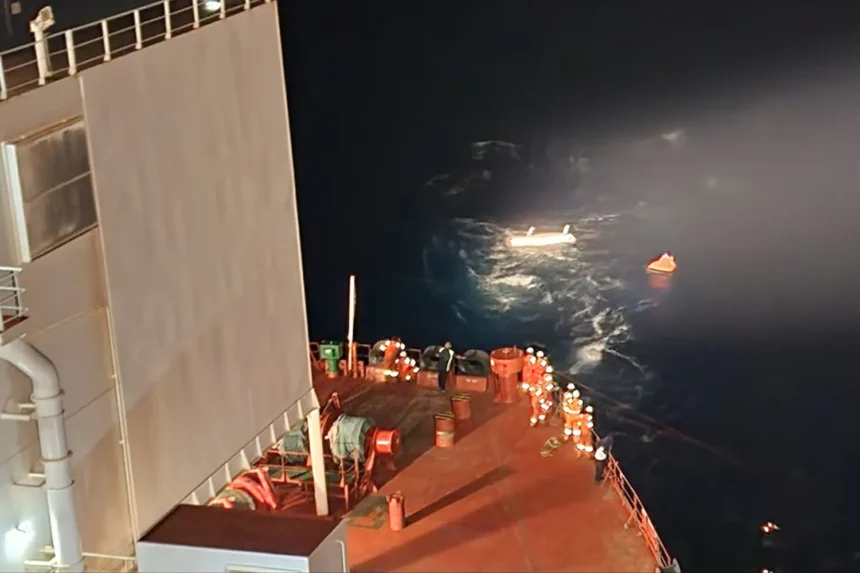
In a dramatic turn of events, Benoit Bourguet, a 47-year-old Belgian solo rower, found himself stranded at sea for 24 hours after his rowboat, City of Liverpool, capsized during the perilous World’s Toughest Row Race.
The race, known for its extreme challenges, took a dangerous turn when Bourguet was hit by two rogue waves in rough seas, with waves reaching heights of 13 to 15 feet. The impact was enough to capsize his boat, leaving him stranded in the open ocean.
A Race Against Time
After the capsize, Bourguet deployed a life raft and activated distress signals, which were quickly picked up by the U.S. Coast Guard. The Coast Guard’s Sector San Juan Command Center immediately launched a rescue operation, but it was the crew of the Horten tanker ship, a Liberian-flagged vessel, that would ultimately make the life-saving rescue.
Despite the severe conditions, the crew of the Horten responded to the distress call, traveling 110 miles over 12 hours to locate Bourguet. The tanker crew found him in the life raft, dehydrated but in overall good condition.
Maritime Safety in Action
This rescue operation was a prime example of the effectiveness of the AMVER program (Automated Mutual-Assistance Vessel Rescue), which encourages ships to assist each other during distress situations at sea. The coordination between the U.S. Coast Guard and the Horten’s crew highlights the importance of quick action and teamwork in maritime emergencies.
The successful rescue underscores the significance of international cooperation in ensuring the safety of individuals participating in extreme challenges like the World’s Toughest Row Race, which spans 3,000 miles across the Atlantic.
The Dangers of Extreme Challenges
Bourguet’s harrowing experience serves as a stark reminder of the risks involved in extreme endurance events like the World’s Toughest Row Race. The event tests the limits of human endurance, with participants rowing alone across vast stretches of ocean, facing unpredictable weather and the potential for accidents.
While Bourguet’s ordeal had a happy ending, it highlights the importance of preparedness, safety measures, and the invaluable assistance provided by maritime organizations in ensuring that participants are kept safe in the face of extreme adversity.
Why It Matters
Benoit Bourguet’s rescue is not just a story of one man’s survival, but a testament to the power of international cooperation, the importance of maritime safety, and the risks faced by those who push themselves to the limit. As extreme challenges like the World’s Toughest Row Race continue to captivate audiences, incidents like these remind us of the human cost behind such feats and the safety measures that can save lives in times of crisis.