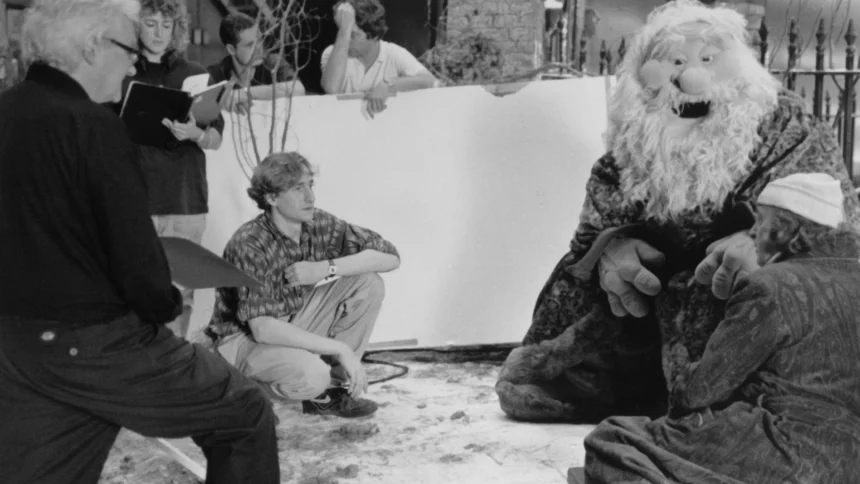
For Brian Henson, Labyrinth has never been just a film credit.
It’s a memory of being young, trusted, and quietly tested — not as the son of a legend, but as a professional expected to deliver. Nearly four decades later, as the film returns to theaters this January, those early lessons feel newly vivid.
Speaking ahead of the re-release, Brian Henson reflected on what it meant to help bring Labyrinth to life at just 22 — and how working alongside his father changed the course of his career.
Growing Up on Set, Learning by Doing
Brian Henson didn’t inherit his career overnight.
As a teenager, he spent long days on sets, absorbing the mechanics of puppetry, animatronics, and performance from the inside out. He learned how characters moved, how systems failed, and how small technical choices shaped emotional moments on screen.
By the early 1980s, he was already working professionally — including on projects outside his father’s company — determined to prove himself on skill rather than surname.
That foundation mattered when Labyrinth arrived.
A Big Responsibility at 22
On Labyrinth, Brian served as puppeteer coordinator, training local performers and managing the complex choreography required to operate the film’s goblins and creatures.
He also voiced Hoggle, one of the story’s most emotionally grounded characters — prickly, loyal, and quietly vulnerable. It was exactly the kind of role that demanded both technical precision and empathy.
Brian’s specialty in advanced animatronic characters made him a natural fit for the film’s challenges, but the responsibility was real. The production was ambitious, expensive, and unforgiving of mistakes.
Working With His Father — as a Colleague
For the first time, Brian wasn’t just learning from his father. He was working beside him.
Jim Henson, who directed Labyrinth, treated collaborators with trust — even when it meant allowing ideas to evolve imperfectly before refining them.
Brian has said he learned more about character development during this project than any other. Jim Henson believed curiosity mattered more than convention. He favored strange, flawed characters over safe, “cute” ones — and trusted his team to explore freely, even if adjustments came later.
That trust extended to his son.
Proving an Identity Beyond the Name
Labyrinth became a turning point.
Not because Brian Henson needed validation from audiences — but because he needed it from himself. The project cemented his confidence that he belonged in the work, not because of lineage, but because of competence.
It also reshaped his relationship with his father. They weren’t just parent and child anymore. They were collaborators, solving creative problems together under pressure.
That shift stayed with Brian long after the cameras stopped rolling.
Why the Film Still Matters
The January theatrical re-release, running from January 8 to 11, offers something modern viewing often can’t.
On the big screen, the craftsmanship becomes unmistakable — the textures of puppets, the physicality of performances, the patience required to make practical effects feel alive. Brian Henson has said the film was always meant to be experienced at scale, where its detail and ambition can fully register.
For longtime fans, it’s a return. For new audiences, it’s a chance to see fantasy built by hand.
A Legacy That Continues Forward
Labyrinth endures not because it chased trends, but because it trusted imagination.
Brian Henson’s reflections reveal how that ethos was passed down — not as instruction, but as example. Curiosity over control. Collaboration over hierarchy. Trust first, refinement later.
Those principles continue to shape The Jim Henson Company today.
Looking Back, Looking Ahead
For Brian Henson, revisiting Labyrinth isn’t about nostalgia.
It’s about remembering the moment he stopped being “Jim Henson’s son” on set — and became simply someone doing the work. The film remains a marker of that transition, frozen in time but still alive in influence.
Some legacies are inherited. Others are earned.
Labyrinth sits quietly at the intersection of both.